Epilogue: The markets speak loudly...

Well, let's recap our story thus far. Young family decides to design and build a modern house that's easy on the planet and well designed for family life, on a budget affordable by work-a-day folks. Initial design development is exciting and the family finds a great team of architects to design a beautiful space. Constraints from the city and the crazy cost of Vancouver construction send the initial cost estimate through the roof. The combination of the initial estimate and the financial meltdown in North America puts the project on hold indefinitely while our young family sorts out the best way forward. Looking back now, that's the way it played out. Hindsight shows us that we were planning the project through the peak of the Vancouver housing and construction markets and both of these have since cooled off substantially. After a bit of a roller coaster ride these last few months (and many nights left sleepless weighing the options) we decided to sell our house (that sat on our to-be-redeveloped lot) and look for a lower-cost, lower-risk solution. We sold our house just after the bizarre inundation of snow that hit us at Christmas and then spent several painful weeks trying to find a suitable replacement. Last week we found that solution - a beautiful architect-designed home in our current neighbourhood at a remarkable price. It's about the same size as the house we were designing (1900 sq ft including a suite below) on a slightly smaller lot. It's about 9 years old and, to our surprise, came available at a price substantially lower than what we could have built for. It's unfortunate that our project had to come to this end but there was only so much risk and debt that we could take on to realize the dream of building a classic house. With the financial crisis and the uncertainty around that, I'm convinced that we would not have been able to raise the required financing for the build and I'm certain that we made the right decision. We'll keep looking out for an opportunity to build but the falling real estate market offered us an opportunity we would have been crazy to pass up... Until next time.


Reality Check

Ouch, that hurt...

Had a meeting with the lads (and their burgeoning staff of architects) today. We met Suzanne and Johannes, the most recent additions to the Measured team, and they both seem like they know what they're doing. Suzanne put together another kick-ass model of the current design for our place (sorry, no photos yet - I'm having upload issues). The lads have made some great tweaks to the design and we had a good conversation about where that's going. We dragged out our list of questions from the last round of drawings and renderings and we made some suggestions about some further tweaks (e.g., softening the interface with the street make the entry more inviting). Luke showed us the latest round of natural light calculations for the suite - largely overshadowed by the main floor but Luke modelled a few potential scenarios to get as much natural light as possible in there.

Then the proverbial poop hit the fan. Earlier in the week (maybe it was last week) we agreed with Clinton that they should bring on their quantity surveyor (smart guy who can derive the construction cost for a building to a remarkable level of detail) to give us an idea of how the design fits the (small) budget. If you haven't seen numbers from a quantity surveyor before, they are generally scary. Usually higher than one wants to see and always backed up by a dizzying amount of detail. In this case the numbers were way higher than we wanted to see. I was prepared for higher (e.g., 20% above our budget) but I wasn't prepared for the 40%+ above our budget that we saw. As Count Floyd (Joe Flaherty on SCTV for you youngsters) would say - "Scary stuff keeds!" Clinton and Matthew were good about suggesting economies to try to help us dig through the rubble of the cost estimate earthquake to find our original budget but at the end of the day we have a serious problem on our hands. Am I the only guy who thinks that it shouldn't cost over $300 a square foot to build with basic finishes and a few green features? The way this budget is headed we'll have stripped out all the green and a big chunk of the living space to get to a workable dollar figure...

What's driving the cost? A bunch of things - of course - because this kind of thing is complicated. But certainly a big part of the problem is parking. As Matthew noted, the parking solution we have to use on our property (because we have no lane and can't park in the setback area) is roughly equivalent to building that many square feet of indoor space. It requires excavation, retaining walls, additional clearance height (to the overhanging main floor) to meet code, etc. There's also the fact that the design has elements on three floors. That's great for our wants/needs (i.e., separating living from sleeping spaces) but it drives lots of exterior surfaces to be sheathed/clad, more stairs wasting square footage and construction dollars, and other real cost drivers.

Perhaps I don't need to tell you that we left the office significantly deflated. We love the design, love the team, but are really queasy about the numbers. I don't know what's next but I do know that Krista and I will be spending some serious time looking at the problem this weekend. Number crunching, re-thinking needs vs wants, and a basic viability assessment are all on the menu for this rainy weekend. We've got some big decisions to make before our planned next meeting on Friday of next week. Wish us luck...
To GSHP or not to GSHP...

The lads at Measured are very keen on ground source heat pumps (GSHP) as the primary heat source for our new house. GSHP is a very promising technology that can, in the right climate, make very good environmental and economic sense. The challenge is the "in the right climate" part of that statement.

I was very keen on GSHP when they first suggested it, seeing the opportunity to one day take the house off the grid if photovoltaic solar comes down to a reasonable price. If you don't know how GSHP works, it's pretty simple. The ground around the house sits at a pretty even temperature (10-15 degrees C) all year round. GSHP takes advantage of that by taking heat from the earth in the winter and putting heat from the surface into the ground in the summer. The GSHP is a pump that pushes liquid through long pipes in the ground (either in a horizontal pattern close to the surface or in a vertical pattern going deep into the ground), and uses a heat exchange process to either heat or cool the house. There's lots of neat physics of heat exchange in the background but in general it's a straightforward process - and a really neat piece of environmentally-friendly technology.

Most GSHP units have a coefficient of performance (COP, which indicates the efficiency of the system) of between 2.5 and 4 - the higher the better. This is based on the fact that it takes less electricity to run the pump than it would take to heat the air in your home using normal electric resistance heating. In essence, with a COP of 3, you're getting three times the heat from the same amount of electricity. Pretty good, eh? The subtlety of GSHP is that if the differential in temperature between the ground and the liquid is small (or shrinks over time), the pump has to run more often to extract the same amount of heat from the ground - thus reducing the COP. And that's a challenge in a climate like Vancouver's where we have a fairly high heating load (we're still in Canada, after all) but very low cooling load in the summer because of our temperate seaside climate. By taking significant amounts of heat out of the ground but not replacing it in the summer, there's a good chance (unless there's an underground creek running by our house) that the ground will cool enough to significantly reduce the COP of the system within a few years. That's a big risk for a system that is costly to install and will need maintenance and care to keep it running in top form.

I think the right approach for our heating solution is to look at using a hydronic heating system (i.e., in-floor radiant heat) with a high-efficiency natural gas boiler. We can set aside an area of the yard for future GSHP vertical well drilling, in case our summer cooling load increases with climate change or the costs of gas go through the roof compared to electricity. A future GSHP could then hook into the hydronic system inside the house with no impact on the internals of the house (other than alterations to fit the GSHP unit). We'll have to talk this through with Clinton - he's probably a bit irritated that I'm writing this - but I've now had two building science nerds counsel us on this and I've done a bunch of side reading on the topic as well... I think the better place to put those dollars is into tightening up the building envellope and reducing our heating needs. But who knows, maybe I'll be posting a retraction in a few months and preaching the gospel of GSHP...


Rendering the First Consultant

Hmmm, maybe that title’s a bit aggressive. Last week we had Clinton and Luke over to the house with a re-use/demolition consultant from the Lighthouse Sustainable Building Centre. Lighthouse is an interesting place – offering a variety of services (including a free reading room/resource centre on Granville Island) to those looking to build in sustainable ways. Eileen Keenan was the Lighthouse rep for the meeting and we had a good discussion of where on the green spectrum we wanted to be. It is, of course, a multi-dimensional problem, with cost, schedule, “greenness”, and design practicality all coming into it. The real drivers, as always, are cost and schedule.

Eileen described a few of the demolition options available and quizzed us on where in the spectrum we would like to be. Of course I piped up with “low cost, high re-use” – choices that generally don’t go together. The saving grace, hopefully, is that we’re willing to do a bunch of the work and we’re able to move out early to give us time to do the demo work. What we end up with remains to be seen but Eileen’s going to put together a report with recommendations on strategy, pointers to resources, and hopefully some guidance for the architects to know what’s available for re-use. I’m confident this effort will be worth it – both financially and in reducing the amount of material in the landfill.


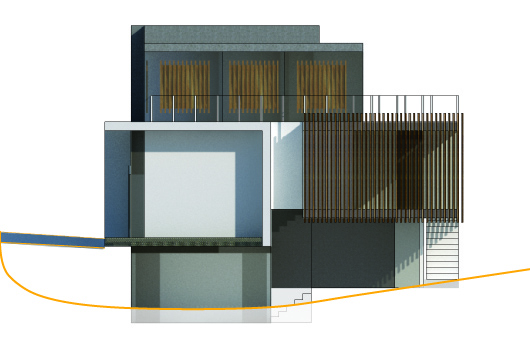
While we were talking re-use inside the house, Luke was outside in the rain getting a handle on the details of our lot – where shading trees are, height of neighbouring houses, etc. This info will now be fed into the environmental modeling of heat, sun, and wind to help us maximize the natural sources of heat, light, and airflow. People talk a lot about using energy efficient lighting and appliances but the beauty of good architecture is that it can give us buildings that require running those lights and appliances as little as possible. Another good sign of progress was the CD of images that Clinton dropped off. It includes a number of sketches we’d seen before but also has a few 3D renderings based on the model and drawings we saw last time. I’ve posted a small version of one of the renderings here. We like most of what we see in the renderings – they confirm some of the things we liked about the model and they raise some questions about the interface with the street. 


So now we're caught up. I have been talking about getting this blog going for ages but I wanted to document some early events and get us caught up to today's status before posting everything. Now we've done that (back-dating early posts so that you can see the temporal progression) and hopefully we can continue to contribute something at least weekly... Come on back for more!


A view from the south - initial rendering of schematic design for the sunniest side of the house.


The Model


Have I mentioned that the lads at Measured have become the “it” firm of western Canadian architecture? Somewhere between our seeing the article in the Sun and now, they have won a Western Living award (Designer of the Year), a “Greenest of the Green” award from Dwell (design porn) Magazine in the US, and have been featured in every corner of the press. The good news is, their business is growing. The challenge, for a while anyway, was getting traction on our project.


Thankfully we have a very strong affinity for these guys and we know we’ve made the right call. That feeling was proven yet again as we went into project meeting #2 in mid September. Krista, Jack, and I were leaving for Winnipeg that afternoon so we stopped by Wolfe Ave for a quick update in the morning. As we walked up the driveway I saw Clinton hunched over a small grey model of a house. I turned to Krista and said something like “I bet you that’s our house and he was hoping to be finished before we got here.” And at that moment he turned around and his face said it all… We learned as we got inside that the primary model maker (not Clinton) would have joined us for the meeting but she was catching up on her sleep. Excellent, I thought, they’re really working this thing! The model, and the new ideas that drove it, were a subtle but significant move forward from the early massing diagrams of the summer. Clinton and Matthew’s vision for the project was clarifying and things are clearly coming together. I spent a good amount of time staring down the model to get a feel for the structure, the views, and the interaction with the lot. At the meeting we also met Luke, a new member of the Measured team who is looking at environmental modeling of the house – using computer tools to assess solar gain, air flow, and related environmental conditions that can help us reduce the heating and cooling loads common in new homes. We want this project to be as “green” as possible and one reason we’ve hired smart designers is to reduce the long-term environmental footprint (and related operating costs). We’re willing to pay a bit more up-front to be better off down the road.


Another great meeting – the advances in the design have us pretty excited!

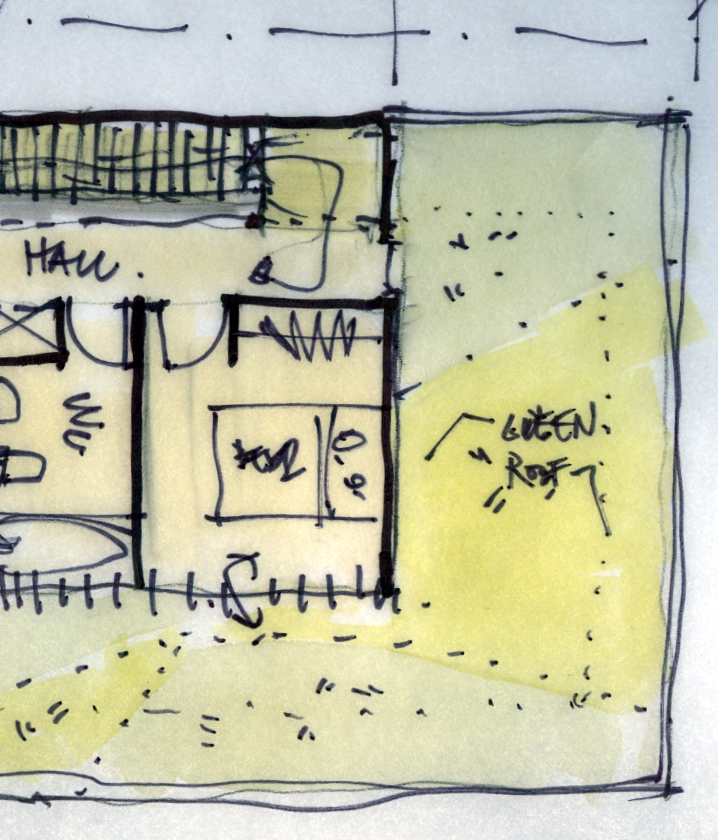
I've included a detail of one of the drawings below. As we post artifacts of the design, we'll likely stick to details or partial views to protect the intellectual property of the folks doing the work. We'll see how it goes and change the plan to fit the needs of the project.

Detail of top floor plan (Sept 08) including one kid's bedroom, part of the WC, and SE elements of the green roof. Not your average post-war brick semi!


The Wall of Fame

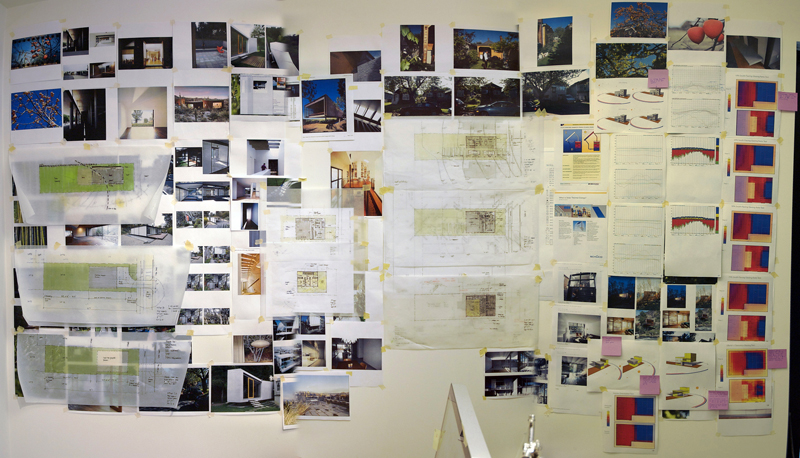
With summer well under way, the lads called us over to the fabulous Wolfe Ave house for our first project meeting. Part of the conceptual design process, the goal was to go over a preliminary program (the spatial goals for the house) and to introduce some concepts that could become part of the design. The program was bang on – 3 bedrooms in the primary space, open living/dining/kitchen space, a couple of bathrooms, and a one-bedroom suite downstairs. The next step was to look at a few massing options – the general shape and size of the house. There were three choices but the clear winner was a version with the kitchen/dining room (with double-height ceiling) sharing the ground level with the suite, master bedroom and living room on the main floor, and then a half floor upstairs with two small bedrooms and a bathroom. Great potential for combined indoor/outdoor space, good entertaining area, and bedrooms upstairs to keep the kid away from the noise. With that decided, we were introduced to the wall of fame (photo below). They had dedicated a wall of the studio to photos, drawings, and information related to our house. They walked us through it, asked our opinion of the photos of houses that they thought would influence our design, and discussed the zoning limits on the lot and where the house was likely to be sited. Curiously, our current house is about 7 feet longer than it’s supposed to be and (as we knew) it’s about 18 inches too close to our neighbour to the north. That means the footprint of the new house will be shorter but a bit wider than the current building. All in all it was a great meeting and we’re excited that the guys are working on things (since we haven’t really thought too much about it).

 The wall of fame - revision 2 including site sketches and other project-related visuals.


The Decision

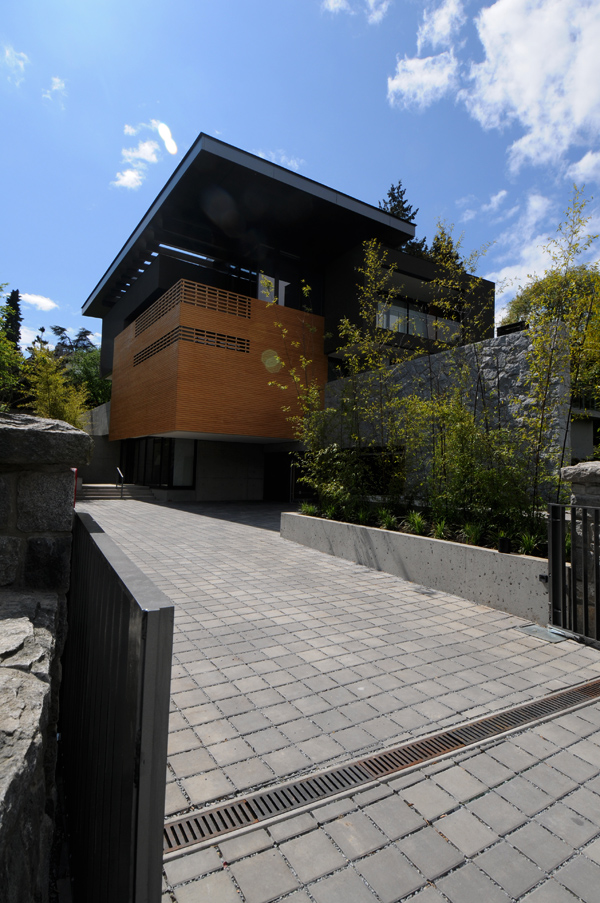
It’s a good thing I was on vacation, and Krista was on mat leave, when we went through this decision process. It was stressful and time consuming – running the numbers, trying to find architects who might be interested in a different kind of project, weighing the risks and benefits of undertaking such a big project, looking at all the options. Luckily for us, the search for an architect was short. One morning I was reading a Vancouver Sun article about an ecologically-minded new house in Shaughnessy, of all places. The architects seemed like interesting guys, with two opposing projects on the go – a 6,000 sq ft high-end home in Shaughnessy (shown below) and a 1,000 sq ft cabin on Mayne Island. On a whim I fired off a quick email to gauge their interest in a small, budget-constrained, project on the East side of town. Fast forward to our first meeting, in the house on Wolfe Ave, and it was clear that we were all on the same page. Despite an early disconnect on budget, our early conversations made it clear that (a) these guys know what they’re doing, and (b) we’re interested in many of the same things in the design and environmental realms. So there’s was never much question that when we finally made the big decision to build new, the guys at Measured Architecture were going to be our choice to design the house. 

That’s when the real fun started…

Wolfe Ave house by Measured Architecture - green building on a larger scale


How We Got Here

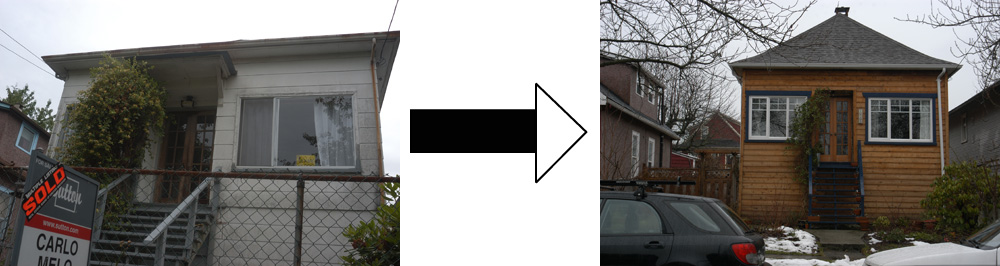
Before/after of the house with asbestos siding & fence versus cedar and no fence. 

When we bought our house in 2003, Krista and I knew we there would be some challenges in staying in it over the long term but we never thought we'd tear it down.

Why did we buy it? We loved the neighbourhood, the price was right, and the yard was an amazing orchard of fruit trees and vines. We figured we could deal with interior issues - we were up for a reno project - but were not prepared for the magnitude of the challenges we'd face.

Our initial renovation - to make the main floor liveable - was a great success. We lived in a tent for six weeks as we gave the main floor a complete makeover - including drywalling and insulating all the walls. Weeks without water and power didn't deter us from turning our crazy little house into a home.

Over the years we did a host of updates to "green" the house - insulation all around, adding a programmable thermostat, new double-pane windows, removal of the asbestos-laden siding, and the replacement of a 1940's era furnace with a 94% efficiency condensing model.

That was the easy part.

From the beginning we had thought of ways to add a few square feet by building out the unused attic space upstairs. Then in late 2006 we pushed hard to get a design together and get started. Over the winter of 2006/2007 we expanded our concept from a single loft bedroom to two small bedrooms and a small bathroom. The plan was to add about 500 square feet and to do some minor reconfiguration of the main floor to make the main and upper floors work well together. In the midst of this, Krista became pregnant with Jack (now 8 months old) and the urgency on the project was on the rise.

The craziness of the Vancouver construction scene, and the protracted city strike of 2007, put the kybosh on our plans to complete a second floor reno before Jack arrived. We got to the point of getting a couple of quotes for the job but we needed a variance - because of the proximity of the original house to the north property line - so we were put on hold by the strike. When the city came back we successfully argued for our variance and got our development permit.


At that point I had steeled myself to a budget that was just about double my original goal. The problem was that those quotes had now expired and when we went back to the market in early 2008, construction pricing had leapt from extreme to ridiculous in a few short months. We were excited to find a contractor we trusted whose initial estimate fell within our budget. Unfortunately, when they ran the detailed numbers we ended up with a quote well outside the realm of reality (~$550/sq ft for just over 500 sq ft) even with significant compromises on project scope.

That was our wake-up call that our attractive, small, and really quite simple reno wasn’t going to work. That gave us a few options:
  • Sell the house and find something in the neighbourhood with the room we needed
  • Shift gears and look at a way to lift and move the house to develop the basement
  • Tear the house down and start from scratch
 Option 2 was never really an option as we didn’t want to live in the basement and without the possibility of a suite, we’d never be able to recover the cost of the reno if we had to sell. Option 1 looked the best and we explored several houses nearby. During a pre-offer inspection of a particularly promising house just down the street, our main-floor contractor (an amazing craftsman and a great guy) let us know that the house needed probably 250K of major renos over the next five years. While he was at it he asked us why we hadn’t considered re-building on our lot. Given the great deal we got on the property, he figured that we could build a 2000 sq ft house for about the same money as we would need to buy the other property and do the required renos.

Until that point we really hadn’t considered tearing down our great little shack. But, as always, Austin was right and when we ran the numbers, it was clear that – in this real estate & construction climate – building new could give us the best bang for the buck. After much discussion on the topic, Krista and I agreed to at least look into the potential of a re-build.

Check out the next posting to find out what happened next…