To GSHP or not to GSHP...

The lads at Measured are very keen on ground source heat pumps (GSHP) as the primary heat source for our new house. GSHP is a very promising technology that can, in the right climate, make very good environmental and economic sense. The challenge is the "in the right climate" part of that statement.

I was very keen on GSHP when they first suggested it, seeing the opportunity to one day take the house off the grid if photovoltaic solar comes down to a reasonable price. If you don't know how GSHP works, it's pretty simple. The ground around the house sits at a pretty even temperature (10-15 degrees C) all year round. GSHP takes advantage of that by taking heat from the earth in the winter and putting heat from the surface into the ground in the summer. The GSHP is a pump that pushes liquid through long pipes in the ground (either in a horizontal pattern close to the surface or in a vertical pattern going deep into the ground), and uses a heat exchange process to either heat or cool the house. There's lots of neat physics of heat exchange in the background but in general it's a straightforward process - and a really neat piece of environmentally-friendly technology.

Most GSHP units have a coefficient of performance (COP, which indicates the efficiency of the system) of between 2.5 and 4 - the higher the better. This is based on the fact that it takes less electricity to run the pump than it would take to heat the air in your home using normal electric resistance heating. In essence, with a COP of 3, you're getting three times the heat from the same amount of electricity. Pretty good, eh? The subtlety of GSHP is that if the differential in temperature between the ground and the liquid is small (or shrinks over time), the pump has to run more often to extract the same amount of heat from the ground - thus reducing the COP. And that's a challenge in a climate like Vancouver's where we have a fairly high heating load (we're still in Canada, after all) but very low cooling load in the summer because of our temperate seaside climate. By taking significant amounts of heat out of the ground but not replacing it in the summer, there's a good chance (unless there's an underground creek running by our house) that the ground will cool enough to significantly reduce the COP of the system within a few years. That's a big risk for a system that is costly to install and will need maintenance and care to keep it running in top form.

I think the right approach for our heating solution is to look at using a hydronic heating system (i.e., in-floor radiant heat) with a high-efficiency natural gas boiler. We can set aside an area of the yard for future GSHP vertical well drilling, in case our summer cooling load increases with climate change or the costs of gas go through the roof compared to electricity. A future GSHP could then hook into the hydronic system inside the house with no impact on the internals of the house (other than alterations to fit the GSHP unit). We'll have to talk this through with Clinton - he's probably a bit irritated that I'm writing this - but I've now had two building science nerds counsel us on this and I've done a bunch of side reading on the topic as well... I think the better place to put those dollars is into tightening up the building envellope and reducing our heating needs. But who knows, maybe I'll be posting a retraction in a few months and preaching the gospel of GSHP...


The First Bill

I'd love to see the look on Clinton's and Matthew's faces as they realize that I'm writing about their first invoice... Just read right through, guys, and things will be ok.

When one starts talking about building or renovating a house, one's friends, family, acquaintances, and hangers-on get very interested in the financial side of it. How much is your budget? Are you borrowing money to do it? What rate did you get? Once people find out we hired an architect they ask things like - Isn't that expensive? I thought you guys were on a tight budget?

Well, we got the first invoice from our architects about two weeks ago. And we happily wrote the cheque on the weekend. Why do I say happily?

Those of you who know me know that I'm cheap. I don't really like to pay for things we don't need - heck, I don't even like paying for some things we do need! Do we really need orange juice? Some would say that we then fit the profile of people who would go down the road of the generic design build - thought to be the cheap solution for a new house. The problem is, I don't think that's the best financial decision. Vancouver is full of evidence that it's not the right design decision - there's no shortage of half-baked design-build houses littering our streets. But financially, it's a more complicated story. Why do we have to build a cookie-cutter, inefficient, mediocre house just because we're on a budget? Why not pay somebody smart (Measured) to create a cost-effective design (to reduce construction costs), an energy efficient design (to reduce operating costs), and a livable, beautiful design (so we never want/need to move)? It seems to me that building is complicated and the best time to bring in people who understand design, building construction, and building science, is up front in the process.

My expectation - yes, I have high expectations for this house - is that Clinton, Matthew, and their crew are going to give us a great house that fits inside our budget. Are we willing to make compromises to do this? Absolutely. I'm much more comfortable paying someone a bit up front to give us the tools to keep construction and operating costs to a minimum. In return, we're looking forward to an interesting building with a great interior plan that is as easy on the planet as we can make it. It can be done, we're going to do it, and yes, it means we have to pay for it. And that's ok with us.
We got the first invoice recently. Are we getting value for our money? Absolutely.


Rendering the First Consultant

Hmmm, maybe that title’s a bit aggressive. Last week we had Clinton and Luke over to the house with a re-use/demolition consultant from the Lighthouse Sustainable Building Centre. Lighthouse is an interesting place – offering a variety of services (including a free reading room/resource centre on Granville Island) to those looking to build in sustainable ways. Eileen Keenan was the Lighthouse rep for the meeting and we had a good discussion of where on the green spectrum we wanted to be. It is, of course, a multi-dimensional problem, with cost, schedule, “greenness”, and design practicality all coming into it. The real drivers, as always, are cost and schedule.

Eileen described a few of the demolition options available and quizzed us on where in the spectrum we would like to be. Of course I piped up with “low cost, high re-use” – choices that generally don’t go together. The saving grace, hopefully, is that we’re willing to do a bunch of the work and we’re able to move out early to give us time to do the demo work. What we end up with remains to be seen but Eileen’s going to put together a report with recommendations on strategy, pointers to resources, and hopefully some guidance for the architects to know what’s available for re-use. I’m confident this effort will be worth it – both financially and in reducing the amount of material in the landfill.


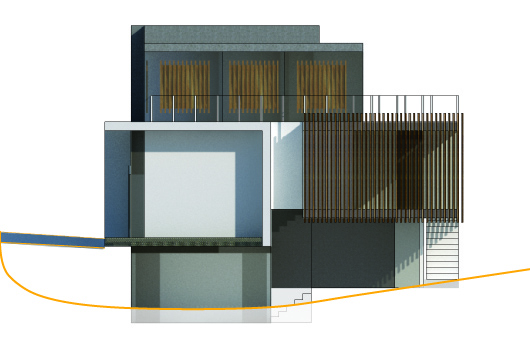
While we were talking re-use inside the house, Luke was outside in the rain getting a handle on the details of our lot – where shading trees are, height of neighbouring houses, etc. This info will now be fed into the environmental modeling of heat, sun, and wind to help us maximize the natural sources of heat, light, and airflow. People talk a lot about using energy efficient lighting and appliances but the beauty of good architecture is that it can give us buildings that require running those lights and appliances as little as possible. Another good sign of progress was the CD of images that Clinton dropped off. It includes a number of sketches we’d seen before but also has a few 3D renderings based on the model and drawings we saw last time. I’ve posted a small version of one of the renderings here. We like most of what we see in the renderings – they confirm some of the things we liked about the model and they raise some questions about the interface with the street. 


So now we're caught up. I have been talking about getting this blog going for ages but I wanted to document some early events and get us caught up to today's status before posting everything. Now we've done that (back-dating early posts so that you can see the temporal progression) and hopefully we can continue to contribute something at least weekly... Come on back for more!


A view from the south - initial rendering of schematic design for the sunniest side of the house.